
Policy Is Everything
That's true for clean energy — and everything else.

This week I take a detour to a topic I always return to: clean energy. Turns out it’s also connected to everything else. But then, isn’t everything connected?
If you enjoy this post please click the ❤️ at the top or bottom. Thank you!
On this Election Day, policy is on my mind.
It may not be the sexiest subject, but it deeply affects our lives at every level.
I’m feeling it in my own life, as my consulting work slows down as a direct result of the Big Ugly Bill — which was not good for clean energy, to put it mildly. We’ll all feel it as that legislation contributes to rising energy bills across the country and slows progress on climate change. In terms of direct economic impacts, red districts will be hit hardest; they disproportionately benefited from the Inflation Reduction Act, which the Big Ugly Bill eroded.
Along with millions of Americans, I’ll also feel the effects of policy when my health insurance subsidy ends in a couple months (thanks, Congressional Democrats, for fighting to extend this!). Many Americans are feeling policy’s effects in other ways, like a woman in her forties I talked to who’s more worried than ever about the possibility of an unplanned pregnancy, because she lives in Texas. Like the immigrants who come here for a better life and now have to fear they’ll be snatched off the streets or from their own homes. Like anyone who’s gay, bi, or trans.
Every aspect of our lives is affected by policy. Every part of our world is affected.
Since I work in clean energy, I’m especially aware of policy’s effects there. I’ve been writing about the importance of policy for solar since 2013. Just look to some of the top states in the U.S. for community solar, like Maine, Minnesota, and New York — or to Germany, which emerged as an early global solar leader despite having as little sunshine as Alaska — and you’ll see that policy trumps sunshine as a solar resource.
We saw that with the Inflation Reduction Act, which in its first year spurred nearly $80 billion in private clean energy investments and which was projected to create more than 9 million jobs over a decade. And we’re seeing it now with the Big Ugly Bill, which will derail much of that progress.
It’s true that solar and wind are now the cheapest forms of new energy generation — even without subsidies like the Investment Tax Credit. (By the way, the U.S. spends an estimated $16 billion to $34 billion annually on fossil fuel subsidies, compared to about $7.4 billion to $15.6 billion for renewable energy.) And some people feel we need to move beyond subsidies.
But policy is about much more than subsidies. Policy affects how quickly a large renewable energy project is connected to the grid and how easily you can get a permit for solar on your home. It affects whether people who can’t put panels on their roof can enjoy the benefits of clean energy through community solar. It affects whether communities can choose where they purchase their energy.
Policy takes the onus from the individual and allows the system to support individual actions. After all, if I can’t get a permit, a good net metering rate, or a tax credit, I’m less likely to put solar panels on my roof.
That brings me back to Election Day.
How do we enact policies favorable for clean energy? According to top energy writer David Roberts, the answer is simple: elect Democrats.
While there are numerous actions you can take in your everyday life to fight climate change, in addition to going solar — reduce food waste and eat less meat, switch your bulbs to LEDs, walk or bike instead of driving, get an induction stove, break up with your mega-bank, switch to a heat pump — one of the most effective actions is to vote. For Democrats.
But it’s hard to vote Democrats into office if our country is gerrymandered up the wazoo.
I mean, how does this map of Texas Congressional districts make sense?
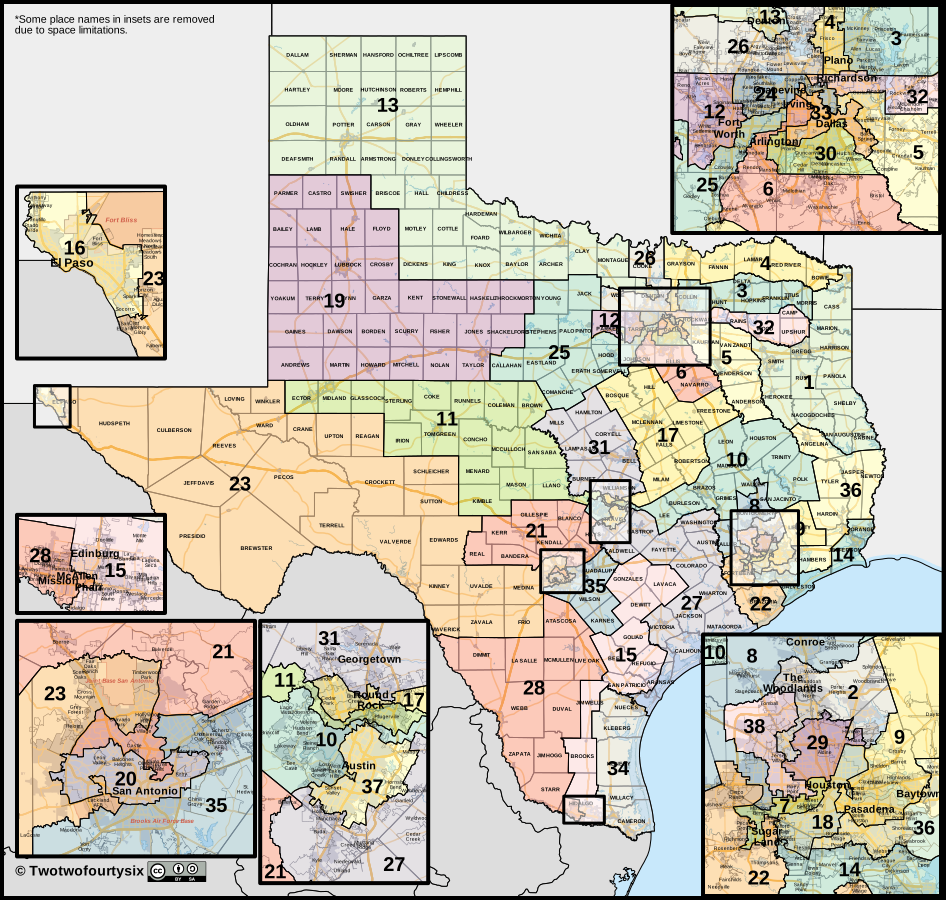
I’m sorry we’re in the position where California is resorting to Proposition 50, a redistricting response to the Texas gerrymandering. I don’t like it, but here we are — and given where we are, I’m glad Democrats are stepping up and fighting back.
As we go to the polls this Election Day, clean energy is just one example of what’s at stake. A vote for Prop 50 is a vote for clean energy, and it’s also a vote for healthcare. For food and housing. For reproductive rights. It’s a vote to make things better for all Americans — whatever their political affiliation.
Okay, I’m starting to sound like I’m making a speech. But seriously, can you imagine a MAGA president passing major legislation that helps supporters of the opposing party even more than his own? That’s what Biden did with the Inflation Reduction Act. He may not have been perfect, but he’s a prime example of what we get when we vote for Democrats. They’re better for clean energy, and they’re better for our country.
Rafael and I already voted for Prop 50 this weekend. I hope it passes, and I hope we get past this crazy era of U.S. politics to one where we can enact rational policies that will move our country forward. Apart from all the other things at stake, we’re in a climate emergency. We can’t delay on fighting it, and that means — in addition to many other actions — deploying much more clean energy. Let’s make it easier to elect more Democrats, so we can make that happen.
I’m late to reading this, Rosana, but what an excellent post! And yay for wins on Tuesday! It’s nice to feel hopeful!
Yay Prop 50! Yay Mamdani! Yay yay yay!