

The Last Gas Station
When will they disappear?

I LOVE it when people tell me how much they like reading Flower Child. And I’m often surprised — not just because they like what I write, but because I didn’t know they were reading it at all.
If you enjoy this post, I’d LOVE it if you’d click the ❤️ at the top or bottom. Thank you so much!!
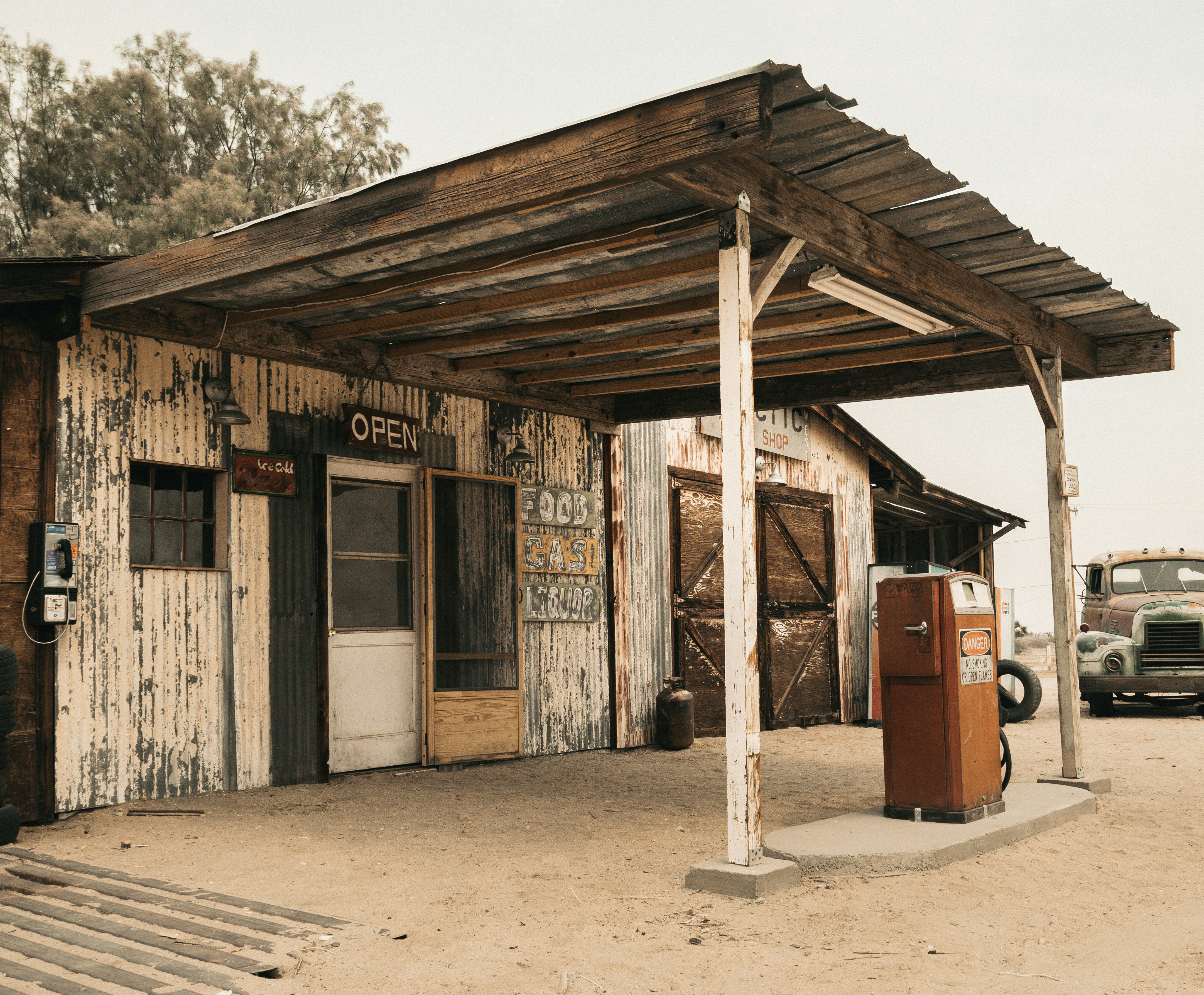
In the mid-2030s, will it be hard to find a gas station?
Some climate researchers think so — at least in places like California, where EV adoption is high.
Okay, so it may not happen that fast — but it will happen. Even if they don’t disappear entirely, and even if it takes a while, eventually gas stations will become hard to find.

Three and a half years ago, I started Flower Child by chronicling an EV road trip Rafael and I took from Oakland, California to Albuquerque and back, with a stop at the Grand Canyon:


It was much more than an excuse to start my Substack; it was a great way to take a vacation. Just looking back at those images makes me feel relaxed. EV road trips are even more relaxing than road trips with cars powered by ICE (internal combustion engines, not the other one), because having to stop to charge the car makes you move more slowly.
But the trip wasn’t as easy as it should have been. If we want more people to drive EVs, we need to make long drives easier — including for people who are in a hurry. That means installing more chargers and ensuring they keep working.
Why should we want more people to drive EVs?
Hey, in case you hadn’t heard, we’re in a climate emergency. If you think it isn’t affecting us yet, talk to my friends in Florida whose home insurance went up to $18,000 a year. Talk to the people in Paradise, California, whose houses burned in a wildfire. Talk to the residents of the Maldives, whose country is disappearing into the sea. We’re all experiencing the climate emergency in ways big and small — even the price of coffee has gone up because of it.
But my point isn’t to convince you about the climate emergency. It’s here and it’s real, whether you like it or not.
Nor is my point that we can fix it by switching to electric cars. In the U.S. in particular, we absolutely should prioritize walkable cities, protected bike lanes, and public transit — none of which we’re doing now. But even if we did all of those, we’d still need to clean up our transportation.
Transportation accounts for about a quarter of global carbon emissions; the percentage is higher in developed countries like the U.S. About 70% of that comes from road vehicles like our cars.
That’s a good reason to switch to EVs. (The war in Iran is a reminder of another one; it could drive the price of gas in California to $6 a gallon. Countries with more solar and EVs are less vulnerable.) The transition isn’t happening fast enough, but it’s starting to pick up speed.
Our EV road trip was mostly fine, thanks to my planning and caution; when we were about to drive a long ways with no public chargers, I made sure the car was fully charged.
But we shouldn’t have to worry about driving a long ways with no public chargers.
Since our Albuquerque trip, Rafael and I have mostly charged at home by plugging our car into a regular outlet, because we don’t drive far most of the time. When we drove over 200 miles round trip to Monterrey, the people we were visiting had a charger we could use — which was good, because all the nearby public chargers I could find were busy. We might have made it both ways on one charge, but I didn’t want to chance it.
In the three and a half years we’ve had our Chevy Bolt, I only had a range problem once — and that was because I hadn’t bothered to fully charge the car and had to unexpectedly drive over 100 miles in one day due to a family emergency:

That day, it was challenging to find an available public charger, which I needed because our home charging method is very slow. Eventually I managed to charge up enough for the day, but the search added stress to an already stressful day.
Since then, more chargers have been appearing near us. I was pleased to see eight new charging stations installed recently at the Berkeley Bowl, where I do a lot of our shopping. I haven’t needed them yet, but I’m glad they’re there.
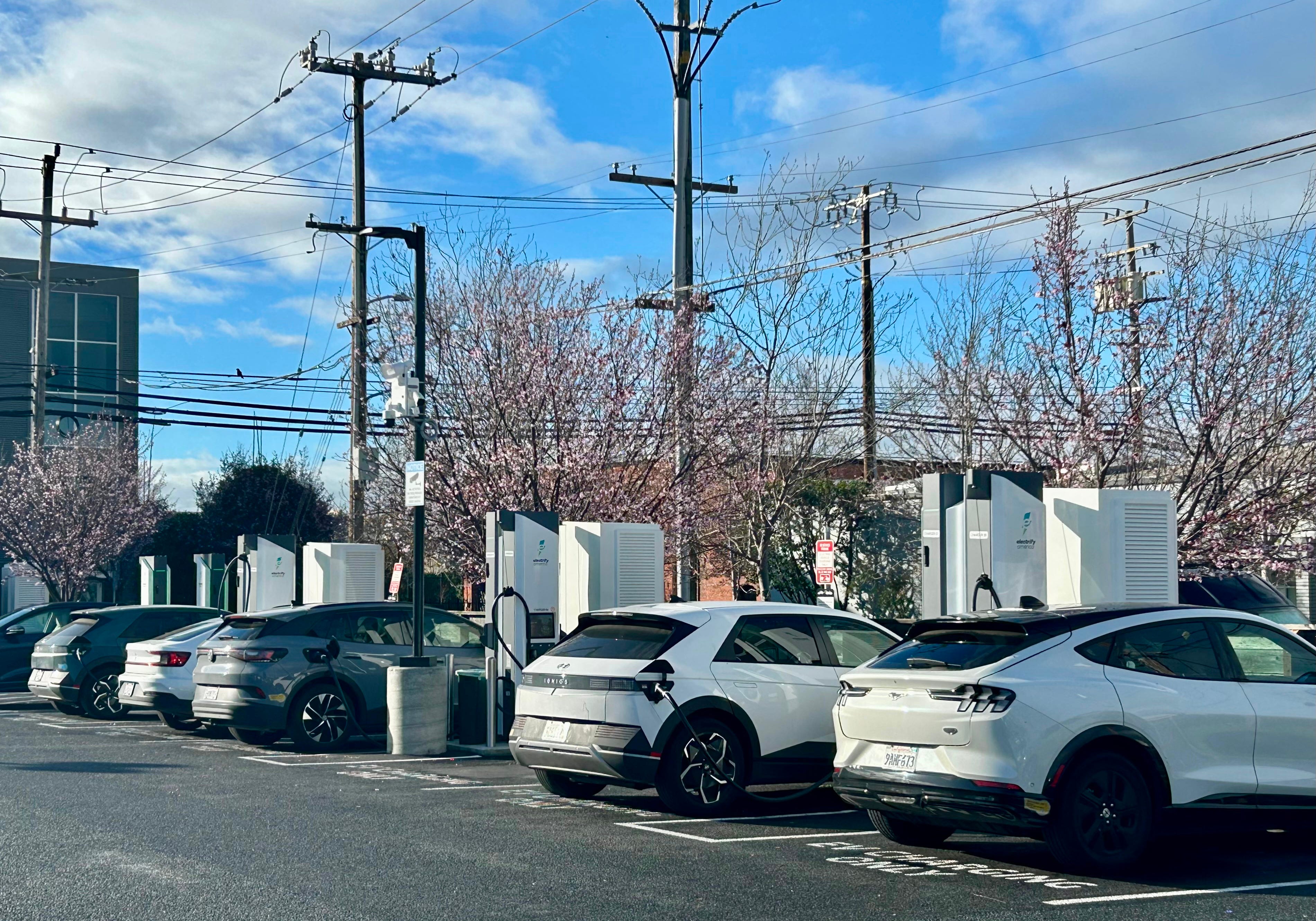
But that’s the Bay Area. How’s EV charging faring across the nation?
The bad news: Our current administration is doing everything they can to stop the EV transition — along with the energy transition. That includes ending EV tax credits and freezing EV charging grants, trying to take over Venezuela’s oil, and requiring 100% domestic materials in EV chargers.
The good news: While they might delay the EV transition, they can’t stop it — and the rest of the world isn’t waiting for us.
Even in the U.S., EV chargers just had a good year. Canary Media reports: “The nation’s public fast-charging network expanded by 30% over the course of 2025, adding 18,041 ports…. That’s up from the 13,970 fast-charging ports deployed in 2024, and way up from the 5,313 installed in 2021.” Definitely more than when we took our 2022 road trip — and Tesla chargers, which we couldn’t use then, are now open to cars like ours with an adapter. Plus, charging has reportedly become more reliable than it was on our trip.
Of course, charging is just part of the EV equation. Anyone wanting to buy an EV in the U.S. has very few choices, especially in the affordable range. Most people I know who want an EV end up buying a Chevy Bolt. It’s a good car, but it shouldn’t be one of just a couple affordable EVs with a decent range (sorry, I don’t consider $30,000 and up affordable).
And it wouldn’t be, if we weren’t limited to just a few EV models.
For all that You-Know-Who used to talk about beating China, he doesn’t seem concerned that China has already overtaken us on EVs. China is making half the world’s EVs, has a trade deal to sell EVs to Canada, and is expanding its EV car sales in Europe and Latin America — unlike the U.S. And they’re making cars with a range of over 600 miles, unheard of here. Okay, the actual range you’d get would be lower, but they still blow us out of the water. Some of their models will charge in five minutes. Oh, and you can buy some Chinese EVs for as little as $9,000.
Except we can’t buy them, because they’re from China. Oh well.
I get that there may be some unsavory reasons why Chinese products are cheaper, but it’s still embarrassing how far behind we are. We could be doing better here in the U.S.
Where does that leave us? We have the Chevy Bolt, back in production after a hiatus of a couple years. There are enough of them now that it’s even possible to buy one used, like we did.
But the dwindling number of car manufacturers here making EVs seem to be focusing on SUVs and trucks, which they say are what the public wants. Maybe so, but Americans are used to options. Some car makers say Americans don’t want EVs at all — but I bet they’d want more affordable EVs with longer ranges that also charge faster. And people are more likely to want EVs if they’re confident we have enough chargers to support their driving needs. At least we’re making some progress there.
Given the current policy turmoil and the lack of options, it will likely be a while till gas stations become hard to find. But we’ve seen before that once we pass a tipping point, technological changes can happen surprisingly fast. The last gas station may be here sooner than we think.
I expect to need a replacement for my 2001 Corolla soon; the cost of repairs in recent years exceed its market value, though my mechanic says I should drive it as long as it will run (just passed 200,000 miles), but I really appreciated some of the new-model safety and convenience features. I'm considering a used hybrid Corolla or Camry. I'd love an EV; the charging challenge is real, but it would be perfect for most of our in-town, in-county (or adjacent county) driving. I haven't priced them yet. Last fall we rented a (gas) Corolla for a 2,000-mile road trip, and there is always that option to supplement owning an EV. Hmm . . .
Yep, I know so many folks who say they'd get an EV if they didn't have to worry so much about charging it. Just one more reason the orange sack of sewage should rot in hell!