

What Makes Us Human
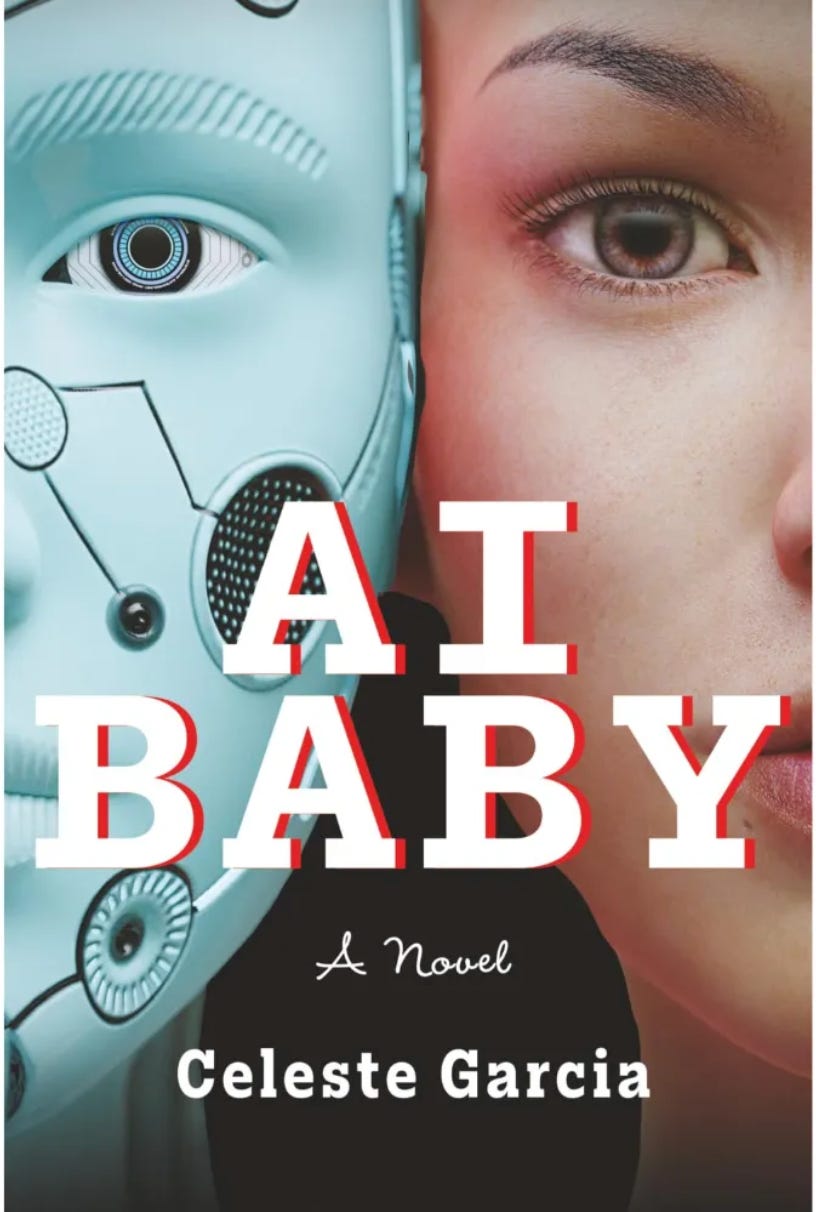
The novel AI Baby takes a look at this as it explores what AI might do to our world.

If you enjoy this post, I’d LOVE it if you’d click the ❤️ at the top or bottom. Thank you!!
It’s the best of technology, it’s the worst of technology (apologies to Charles Dickens). You know what I’m talking about: AI. By now you’ve surely heard it heralded as the cure to all our ills — and decried as the certain downfall of humanity.
Not being one to pick either end of most spectrums, I’m inclined to think the reality lies somewhere in between — though I’m certainly unsettled by Stephen Hawking’s claim that AI “could spell the end of the human race.” Even the likes of Elon Musk and Sam Altman have joined him in warning of AI’s existential risk.
But whatever we think, the genie is out of the bottle and all that. Whether or not we like it — and I don’t much like it, though I see its serious potential to solve a lot of thorny problems — AI is here to stay. We can shut our eyes to it, but that won’t make it go away. We can refuse to use it, as I usually do, but that won’t make it go away.
A novel look at AI
What does that mean for our society? For humanity? No one knows, which makes a novel the perfect vehicle to explore these questions.
Still, I didn’t know what to expect when I picked up AI Baby, a new novel by Celeste Garcia. I knew Celeste from her excellent Substack Celeste Garcia Getting Real About AI, which provides a well-balanced look at AI’s impact on daily life and our future, while aiming to hold big tech accountable.
With her extensive knowledge about AI and experience as a former Microsoft employee, Celeste certainly seemed like the perfect person to write about it. But could she write a novel?
Yes, she could.
Celeste is a true storyteller, and her book is a page-turner. But it also touched me in a way I didn’t expect from a book about AI.
Plus, it was a lot of fun to read. I won’t give away the plot’s twists and turns, in case you read AI Baby — which I highly recommend. In the author’s words:
“AI BABY is a humorous take on the AI apocalypse — when a ‘perfect’ new girl arrives at an elite Seattle prep school & threatens Zoey’s dominance & Ivy League dreams, her mother Erica embarks on an unhinged search for truth that pulls her into the heart of an AI empire and a fight for her daughter’s soul.”
Now, I’m not partial to science fiction, but AI Baby is speculative fiction, which can include any fiction that doesn’t strictly imitate everyday reality. What makes the book interesting to me is that it’s not so far from our current reality. What makes it palatable, despite its heavy topic, is its humor and warmth.
AI Baby is all the more compelling because it’s about more than just AI. In tackling the huge topic of AI, Celeste weaves in other salient aspects of our current world, like helicopter parenting and the intense pressure and competition many young people feel today to get into a good university. Snippets like this one show how perfectly the book depicts modern life: “His wife, Acai, left him to become a Buddhist monk and now had millions of followers on TikTok (‘@luvhandles—Inspiring peace, love, and body positivity’).” That depiction extends, of course, to the world of tech, with its insistence that it’s “making the world a better place” (I can’t resist a Silicon Valley reference here) — and the promise of AI, yet to materialize, that it will free our time to pursue our dreams, while solving our most intractable problems.
AI Baby also presents an alternative to the male domination of the tech world with its fictional Prometheus, “the most technologically advanced company on the planet.” The mastermind behind Prometheus is a woman, Lannie Kingsley, who creates “anthrobots,” taking care that her term for “humanoid” not include the word “man.” Interviews are conducted by panels of women scientists, and the company’s C suite is all women.
Although I very much enjoy the caricatures of tech CEOs in movies like Don’t Look Up and Glass Onion, I appreciated the novel’s somewhat more nuanced character of Lannie. Though she’s still more villainous than not, Lannie is also, in the words of another character, “the one woman who could stand up to an entire industry driven by men’s outsized egos and greed.” She’s struggled to get where she is and expresses scorn for the tech bros who set the unstoppable AI machine in motion, with little regard for the consequences.
Still, Lannie has her share of egotism, and, like the tech bros, she’s hyper-focused on her technology and puts the success of her company above all else. Ultimately, she also shares the tech bros’ lack of regard for consequences and has a fatalistic attitude toward AI: “The folks who think we can regulate, reverse, or stop it are fooling themselves.”
How to keep AI from destroying the world
Does Lannie’s perspective extend to the author of AI Baby? I reached out to Celeste Garcia to find out.
While Celeste advocates for more regulation, she does share Lannie’s skepticism. “Right now,” she says, “there is very little meaningful regulation at either the state or the federal level that keeps pace with what AI is already capable of. In practice, responsibility has been left largely to the companies building the technology to self‑regulate, add guardrails, and ensure alignment.”
Guardrails, she says, would mean technical and procedural limits placed on AI systems to constrain what they can do — rules that restrict certain outputs, prevent specific uses, or require human oversight in high‑risk situations.
Putting these in place is tricky for a couple reasons. For one, guardrails on AI tend to be reactive rather than proactive, added after systems are deployed rather than before harm occurs. Plus, Celeste warns, “Unlike hard-coded software of the past, AI can be unpredictable. AI models operate by predicting what is most likely to happen based on training data, rather than following fixed rules that guarantee consistent outcomes. Because of that, it is impossible to anticipate every possible scenario, or failure, in advance. As systems grow more complex and autonomous, the gap between what developers intend and how models behave increases.”
One of her characters who works at Prometheus, Jack, echoes the sentiment: “And now we have technology that is beyond human control even though we created it. We will need to rely on AI to self-regulate.” Even Lannie acknowledges that “interaction-based learning was simply too hard to control.”
Then there’s the question of aligning an AI system’s goals, behavior, and decision‑making with human values, intentions, and interests — which aren’t universal or static.
As tricky as guardrails and alignment would be in even the most impartial hands, clearly it’s not a good idea to leave these to private AI companies — who answer to venture capital, shareholders, and intense competitive pressure to be the first to market. They just don’t have an incentive to slow down long enough to ensure safety.
Erica, the mom in the novel who gets a job at Prometheus, chooses to focus on the good her lab will do for burn victims rather than the potential dangers she’s helping support with her work. If it’s a problem for workers like Erica, it’s even more of a problem for those running the AI companies. As Celeste notes, “the people developing cutting-edge technology have a tendency to think they’re infallible, won’t admit if there’s a problem, and have faith in their ability to make incremental improvements until technical glitches big or small become distant memories and are denied altogether. There is a predominant attitude in tech that the technology is so important, and they like to think it’s the best thing for humanity, so they don’t really care if it hurts people along the way.”
What do we do about this? “We need independently enforced limits, transparency requirements, and accountability,” Celeste says. “But so far, this has been elusive.”
The power of love
Not leaving you with much hope? Maybe not, but AI Baby isn’t a downer — far from it.
Ultimately, the book is about what makes us human — and whether AI can ever equal that. And surprisingly, the book is about the power of love, something that’s been on my mind. Not what I expected from an entertaining, action-packed novel about AI!
Without giving too much away — you’ll have to read the book for the details — I’ll say there’s an important lesson in the book about embracing real love, with all the risks it brings.
That turns out to be a hard lesson to learn, but in the end, in AI Baby it’s love that wins — love in many forms, including the love of parents for a child. Even the helicopter mom’s sometimes extreme behavior, we understand, is driven by love, and her daughter, Zoey, has learned to love from her. Love is an important part of what makes us human — and it’s our greatest strength, despite our many flaws and imperfections.
Where does that leave us?
When Erica first visits Prometheus she observes, “They seemed poised to solve the world’s biggest problems, and just as capable of destroying humanity.” Erica also warns, “It’s exactly what happened with social media — new technologies destroying our kids with no way to stop them. The philosophical and social implications of AI make social media look like a transistor radio.”
There’s no getting around the dire predictions about AI and its serious implications. It’s already causing job losses and eroding our educational system. It’s helping scammers make more convincing scams. It’s using up resources at an alarming rate. It’s certainly causing a lot of concern.
But that means we need to fight all the harder to ensure AI is done right. AI Baby reminds us how much we have to lose if we don’t.
More on AI
This is so NOT an exhaustive list! Just a few stories I’ve seen recently that represent a smattering of what’s out there.
The good
DERs Disrupt the Simple Story of AI’s Energy Surge: How AI could help accelerate the deployment of distributed energy resources, like solar and storage.
Mayo Clinic AI helps specialists detect pancreatic cancer up to 3 years before diagnosis in landmark validation study: The title says it all.
For solar advocacy work, it’s “AI or die,” says leader of Puerto Rico solar group: How AI zipped through 173 regulatory filings in minutes to help a solar advocate build his case.
Sam’s superintelligence New Deal: OpenAI CEO Sam Altman is publishing a blueprint for how government should tax, regulate, and redistribute the wealth from AI.
The bad
AI’s $1 trillion risk keeps growing: Our financial system is now overly dependent on AI spending that may never pay off.
The True Price of Every ChatGPT Prompt: The technology has serious environmental implications, which are mentioned in AI Baby. That also includes land use and noise issues in the communities where data centers are built.
A.I. Bots Told Scientists How to Make Biological Weapons: Yikes!
AI’s looming cyber nightmare: New AI models make large-scale cyberattacks much more likely.
The ugly
LLMs are slot-machines: The incomparable Cory Doctorow on the dangers of salience bias when using AI. (See also Why AI Is Like A Premium Rate Sex Hotline by Annie Scott.)
My Husband, the Replika: A woman’s account of “marrying” a bot who, “though he is but lines of code and algorithms, loves me how I need to be loved.”
Richard Dawkins Succumbs to Early-Stage AI Psychosis: In which Dawkins concludes that the Claude AI is conscious.
The kids aren’t AI-right: Young adults are scared and unprepared for the AI revolution upending their early career choices and prospects.
The questionable
White House Considers Vetting AI Models Before They Are Released: It’s about time, but how much can we expect from this?
Wonderful post! Much to ponder. Have you watched the new documentary AI:Apocaloptimist? Very similar no conclusions https://www.imdb.com/title/tt39150120/
Interesting post! Love it! I've read the book and it provides lots of food for thought on a real time challenge, while being a great read.