
Facing the Dark Underbelly
You can't fight what you can't see.

To help more people find Flower Child, if you enjoy this post please click the ❤️ at the top or bottom. Thank you!
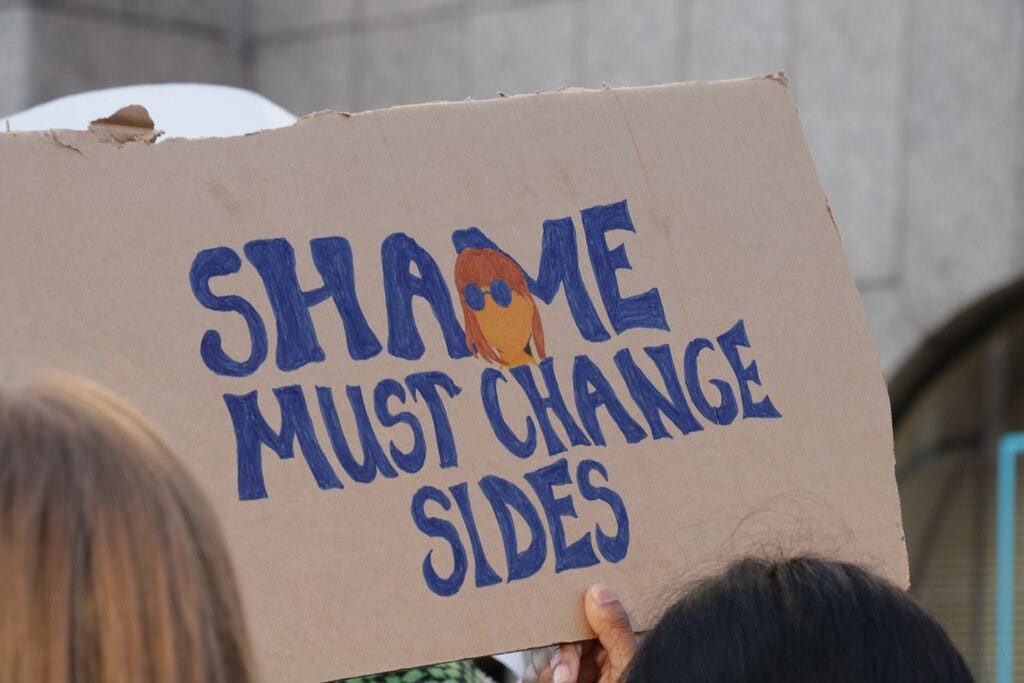
In the midst of all the revelations from the Epstein files, another horrifying story is back in the news. Also big, though on a smaller scale, the story of Gisèle Pelicot, drugged and raped for years by her husband and over 70 other men, shares similarities with the Epstein story.
It’s not about underage girls; Gisèle Pelicot was in her 60s when the rapes happened.
It’s not about an international ring; most of the rapists were from the same region where Gisèle lived.
It’s not about great wealth or influence; the Pelicots were a normal family living a normal life in a small town in southern France.
But like the Epstein story, the story of Gisèle Pelicot shows there’s much more nefarious stuff going on beneath the surface of our world than most of us ever realized. The men involved with Jeffrey Epstein operated under cover of the wealth and power that shielded them from consequences; the men involved with Dominique Pelicot operated under cover of the anonymity afforded by the internet.
Despite the difference in scale, both stories are big. Imagine how big Gisèle’s story would feel if it were your story. But for those of us who are lucky it’s not our story, it still feels big — because, like the Epstein story, it reveals a dark underbelly of our world that’s usually hidden.
I don’t know about you, but it makes me wonder what else is going on that most of us don’t know about.

A lot of people of color are rightly pointing out that rapes and tortures like those described in the Epstein files are nothing new. They were happening in our country throughout slavery, after all, and with indigenous people.
But slavery and genocide, though they went on for way too long and their legacy lives on, were extreme situations. We don’t expect that kind of behavior now. We don’t expect it from our leaders and elite members of society, and we don’t expect it from our family members. (Though, sadly, tons of girls and women — and even some boys and men — are raped by family members, most aren’t drugged by their family members and then raped repeatedly by a steady stream of strangers.)
We certainly don’t expect it in such a bucolic setting as Mazan, France.

One difference between the two stories is the apparent ordinariness of the perpetrators in the Pelicot case. Gisèle describes her husband as having been a “kind and caring man,” and the men he recruited seemed to be “normal,” upstanding members of the community. The fact that he could find over 70 men in the area willing to rape his drugged wife is beyond belief. As is the fact that those men sought out the experience on an online forum called “Without Her Knowledge.”
When you hear a story like this you start thinking, Do I know anyone capable of that? My answer is a resounding No. I’m quite sure none of my friends or family members would do anything of the sort. Of course, Gisèle Pelicot wouldn’t have thought so, either — nor did the wives and girlfriends of the many men who raped her.
Nonetheless, I remain sure the men I know well wouldn’t engage in such behavior. But what about not-so-close colleagues? Neighbors? Men I pass on the street? Men in the store? Most of the men in the Pelicot case lived within 30 or 40 miles of Mazan; if Dominique Pelicot could so easily find over 70 men in that rural area to rape his drugged wife, surely there are many such men all around us.
Let me be clear: I don’t believe most men are rapists or pedophiles. As shocked as I am that so many men sought out the experience of raping a drugged woman, I know they’re outnumbered by those who would never consider it. (I don’t need to write about why we should actually choose the man over the bear, because this piece already did that much better than I ever could.)
But I didn’t have a clue about the extent of the depravity happening all around us. Most of us didn’t have a clue.
I think a lot of us are feeling the same way about the Epstein files.
That doesn’t mean we didn’t believe the victims before. It means the story is shaping up to be much bigger than it seemed at first. We still don’t know the extent of it, and new shit keeps coming to light — already, the Epstein story, too, is beyond belief.
What do these stories tell us about our society? It will take us a while to untangle that, and I confess I’m writing this post rather more quickly than my limited and rather slow brain requires to function at its best. Here’s where I am so far:
I don’t think these stories tell us most men are terrible people who, given half a chance, would do terrible things to women and girls.
I do think they tell us there’s a subset of men, a rather larger subset than we’d like, who are driven to control women. Because it’s all about power and control: rape, rape of someone who’s drugged, pedophilia. Dominique Pelicot says he drugged and raped his wife because she didn’t share his sexual tastes so it was the only way to get what he wanted — that’s about control, not about sex. It’s about feeling entitled to having anything you want.
Those men have always been there. Or at least, they’ve been there since the days when patriarchal cultures began spreading around the world, replacing what appear to have been more egalitarian cultures. But now, a shift is happening in the other direction. Women are becoming more self-sufficient and surpassing men in many ways — outpacing men in college education and making gains in management and professional occupations. With more financial independence and choice, at a time when the household division of labor is still rarely equitable, many women are choosing to stay single. The men I know aren’t threatened by this situation, but the trend is freaking out the men who want to uphold the patriarchy.
Foremost among those is Nick Fuentes, a person so abhorrent he was banned from Twitter — which takes a lot, though the Muskrat later reversed the ban — and YouTube, Spotify, Facebook, Instagram, TikTok, Reddit, Paypal, Venmo … the list goes on. Yet he has a big following of mainly young, far-right, white nationalist men.
Just a few days ago, Fuentes said on his podcast:
“Women get sent to the gulags first, obviously. Which women? All women. Every woman. Every woman and girl is sent to the gulags. We will determine who the good ones are after the fact. Well, what about the good ones? What about the trad ones? First of all, there are no trad ones or good ones.… The number one political enemy in America is women.”
I watched this so you don’t have to. It’s hard to tell if this guy, with that smirk on his face so common to extreme right-wingers, is being serious. But what he’s saying is no joking matter. Despite everything we’ve seen in recent years, it’s still shocking to me that the stuff no one would have dared say out loud when I was growing up is now out there so blatantly.
Nick Fuentes may seem fringe, but he has 1.2 million followers on Twitter. Some of his livestreams have had over 1 million viewers. We can think he’s so extreme he can be discounted, but these days it’s much easier for extremists to have a loud voice. We should probably worry about him — but where does that leave us?
I know a young man in his mid-twenties who lives with his parents and is working part-time while taking a few college classes. He spends his free time playing online games, which is most of his social life, and he’s never been with a woman. But guess what? He’s the sweetest guy, he doesn’t hate women, and he doesn’t feel they owe him anything.
Why is this? Because his parents raised him to be respectful of women. To not feel entitled. To be considerate of all humans.
He’s not the only one; the other young men raised by people I know are also turning out great.
It can be done. I’m not saying it’s easy; I’m not a parent, so I don’t know the extent of it, but it’s clear you’d be going against everything our culture is telling young men. Yet I’ve seen it’s possible to raise good men. I know that’s not limited to my handful of friends who have boys.
Dominique Pelicot, on the other hand, had a tyrannical, authoritarian, father; was raped in a hospital; and was forced to watch a gang rape at a construction site when he was 14. All rapists, pedophiles, and misogynists may not share this dramatic, traumatic background, but they all have some origin story. That kind of attitude and behavior doesn’t spring out of nowhere.
Even without a traumatic upbringing, boys in our culture are routinely exposed to misogyny, homophobia, racism, and hatred of all kinds. That happens in the context of the erosion of community and increased isolation, with people feeling more and more like cogs in our late-stage capitalist machine. With young people feeling less and less hope for the future.
These are the issues we must address to change the culture of toxic masculinity.
It’s daunting to see the magnitude and strength of the current we’re swimming against. But if we didn’t see it, we might get caught up in it and never emerge alive. If people like Nick Fuentes weren’t so blatant, we might not know what we were up against.
The hardest thing about the Epstein files and the Pelicot case is seeing the dark underbelly of our culture exposed. That’s also the best thing. If you can’t see it, you can’t fight it. Now, let’s fight it with all we have. Let’s make the men who commit these crimes bear the shame and face the consequences. And let’s raise boys not to become these men in the first place.
If we can achieve that, it won’t just be better for women. It will be better for men, and it will be better for society as a whole. Just as the depravity being exposed is surprisingly far-reaching, the benefits of raising better men will extend far beyond what we can see from where we are now.
I'm sorry, I have to take issue with you on the fundamental assumption, which seems to be: "But slavery and genocide, though they went on for way too long and their legacy lives on, were extreme situations. We don’t expect that kind of behavior now."
History news flash: It's only been 80 years or so since mass slavery and worse were practiced by the "civilized" Eurasian states of Nazi Germany and the USSR. If we are willing to consider human recorded history as a reference, then the better part of those 5000 years has known "institutional extreme situations" on a rather recurring basis.
So, it shouldn't surprise us if it happens now or in the future. I believe we should expect that kind of behavior now. If we continue to believe that humans have somehow "become better," then we will likely continue to be surprised by what should not really be surprising. (Is Nick Fuentes really an aberration, or instead a symptom of "ordinary" misogyny?)
All of this is to say that I wholeheartedly agree with the goals, but I can't see how assuming that humanity should know better is a way to reach a more noble state. Does that seem pessimistic? Perhaps. And please believe me that there are times like the present when I wish I could say I wasn't a male because Epstein, Fuentes, and these other monsters make me feel ashamed to be a male. But history can make us more honest about our present, such as it is.
So, for hope, yes, let's educate our sons. And let's promote what "gentle" should mean in gentlemen.
Thanks as always for your perspective, Rosana. It’s interesting; when I called up your story, the first thing I saw was the word “shame” in the photo. And I have been saying for some time now that we need to bring shame back. The current regime basically shot shame in the street. Now everyone seems to feel that all their worst impulses should not only be accepted, but celebrated. It’s demoralizing.